Further to Bright Alorwoyie post on the discussions of the above topic in LinkedIn and the subsequent comments by Dr Erasmus L Owusu, PhD thereafter, SumsureIQ would like to expatiate the topic based on evidence from our Field Data Collection, Insights and Reports.
Summary:
Based on SumsureIQ monthly retail audit and consumer insight patterns, the FMCG products that “do not move” in Ghana typically fail because of distribution gaps, mis-aligned pricing/pack architecture, weak brand equity, poor channel strategy, and low consumer relevance. These are the recurring structural reasons visible across SumsureIQ’s sRetailIQ and sConsumerIQ datasets and reports.
Below is a structured, evidence‑based breakdown aligned with how SumsureIQ diagnoses under-performance.
1. Distribution Failure (The #1 reason products do not move)
SumsureIQ’s retail audit data consistently shows that availability and numeric and weighted distributions are the strongest predictors of FMCG sales in Ghana. Products often fail not because consumers reject them, but because they never reach enough outlets.
Key patterns:
- Low numeric distribution in Traditional Trade, which still accounts for the majority of FMCG volume.
- Weak penetration in high‑velocity channels (e.g., tabletop kiosks, Open Market, Groceries and Mini shops, Semi-Retailers, Hawkers and others).
- Poor last‑mile execution like out-of-stock, inconsistent supply, or irregular delivery cycles.
- Over‑reliance on Modern Trade for promotion, which contributes a small share of national/total country FMCG volumes.
SumsureIQ repeatedly emphasises that brands must “track performance and distribution across Ghana” because distribution gaps are the most common cause of under-performance.
2. Wrong Pricing and Pack-Size Architecture
SumsureIQ’s 2025 data shows premiumisation, but also persistent cost‑of‑living pressures. Products fail when their pricing does not match Ghanaian value perception.
Typical issues:
- Price points above key psychological thresholds (GHS 1, GHS 2, GHS 5, GHS 10).
- Pack-sizes that do not match daily cash‑flow realities (e.g., only offering large packs in a sachet‑driven market).
- Failure to adjust prices during inflationary spikes, causing consumers to switch to cheaper substitutes.
- Mis-match between value proposition and price premium, especially in beverages and non-food categories.
3. Weak Brand Equity or Low Consumer Trust
SumsureIQ’s consumer panel (sConsumerIQ) shows that Ghanaian consumers are brand‑loyal in food staples but value‑driven in beverages and non-foods.
Products under-perform when:
- They lack recognition or heritage in categories dominated by legacy brands (e.g., Alamo, Club Beer, Gino, Maggi, Fanice, Onga, Ideal, Coca-Cola, Tasty Tom, Frytol, Voltic and others).
- Packaging looks unfamiliar or “foreign” or even poor in a way that reduces trust.
- They fail to communicate functional benefits clearly (e.g., taste, aroma, efficacy, nutrition).
In categories like rice, edible oil, milk, and tomato mixes where SumsureIQ reports strong growth, brands with weak equity simply get ignored.
4. Poor Channel Strategy (Mis-allocation of effort)
SumsureIQ’s retail audit insights show that channel performance varies sharply across Ghana. Products fail when they are pushed into the wrong channels.
Common mistakes:
- Focusing on Modern Trade/Supermarkets while ignoring Open Market, Mini Stores and Traditional shops.
- Under-investing in Petrol Marts, which are high‑margin impulse channels.
- Ignoring regional channel differences – e.g., Northern Ghana’s strong demand for certain food staples compared to the Southern parts.
- Not tailoring SKUs to channel realities (e.g., large bottles in kiosks where sachets dominate).
SumsureIQ explicitly lists “channel performance diagnostics” as a core use case because mis-aligned channel strategy is a major cause of low movement.
5. Mis-aligned Product-Market Fit
Some products simply do not match Ghanaian consumption behaviour.
Examples from SumsureIQ category trends:
- Non-Food categories (e.g., home care, personal care) grew the slowest in 2025. Products in these categories struggle unless they offer strong value.
- Non-Alcoholic Beverages saw only modest volume growth; new entrants struggle unless they differentiate strongly.
- Alcoholic beverages grew in value but not volume relatively – meaning consumers are buying better, not more. New low‑equity brands get squeezed out.
Products fail when they:
- Do not solve a real consumer problem.
- Enter saturated categories without differentiation.
- Offer benefits consumers do not prioritise.
6. Competitive Pressure from Dominant Players
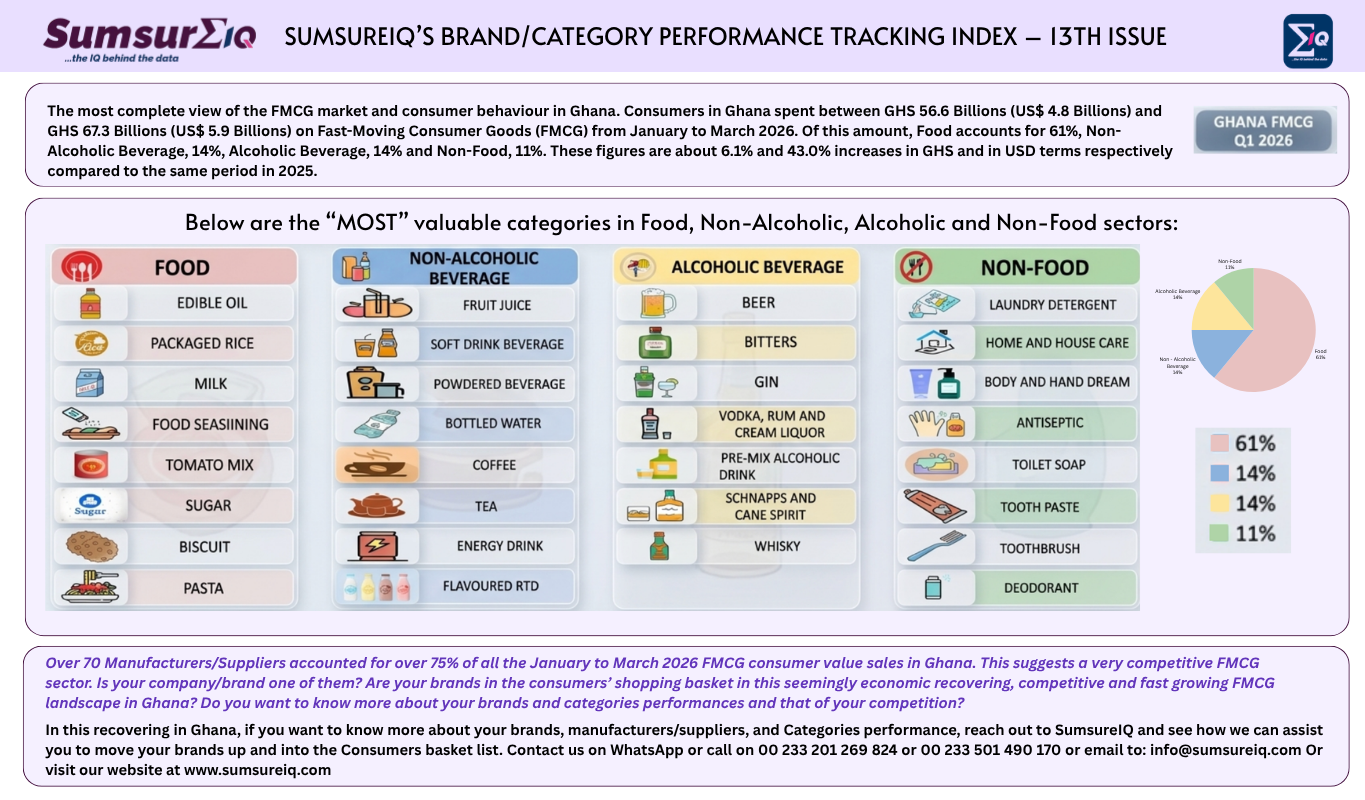
SumsureIQ’s 2025 data shows that over 60 manufacturers control 75% of FMCG value sales – a highly competitive landscape.
Products fail when:
- They compete directly with entrenched brands (e.g., Alamo, Club Beer, Gino, Maggi, Fanice, Onga, Ideal, Coca-Cola, Tasty Tom, Frytol, Voltic and others).
- They lack marketing support to break through clutter.
- Competitors out-spend them in trade promotions and visibility.
7. Lack of Continuous Measurement & Strategy Adjustment
SumsureIQ emphasises that brands must track “What is happening? Why is it happening? What should we do next?”
Products fail when Company Executives, Marketing and Sales Directors and Brand Managers
- Do not monitor monthly retail audit trends.
- Do not use 360 degrees FMCG Market Research Data and insights like SumsureIQ data.
- Do not adjust pricing or distribution quickly.
- Do not test pack-sizes or promotions.
- Do not assess the Return-on-Investment (ROI) after promotion
- Do not benchmark against competitors.
This is why SumsureIQ positions itself as the “IQ behind the data” – to support and prevent exactly these failures.
Conclusion: The Real Reasons FMCG Products “Do not Move” in Ghana are:
- Distribution gaps (most common).
- Wrong pricing/pack architecture.
- Weak brand equity.
- Poor channel strategy.
- Mis-aligned product-market fit.
- Strong competitive pressure.
- Lack of continuous measurement and adjustment.
Follow SumsureIQ for more discussions on the FMCG sector.
Are you a manufacturer/Retailer, a stakeholder or a player in the FMCG market in any African country? Are you leveraging real-time retail insights to scale your business for growth?
If you wish to leverage real-time retail audit data to improve your categories and brands share performances, SumsureIQ (www.sumsureiq.com) is ready to have a discussion with you.
Please visit our website and contact us: www.sumsureiq.com
#FMCG #FMCGSector #sRetailIQ #sConsumerIQ #sConsultancyIQ #SumsureIQ #ExchangeRates #GhanaFMCG #Prices