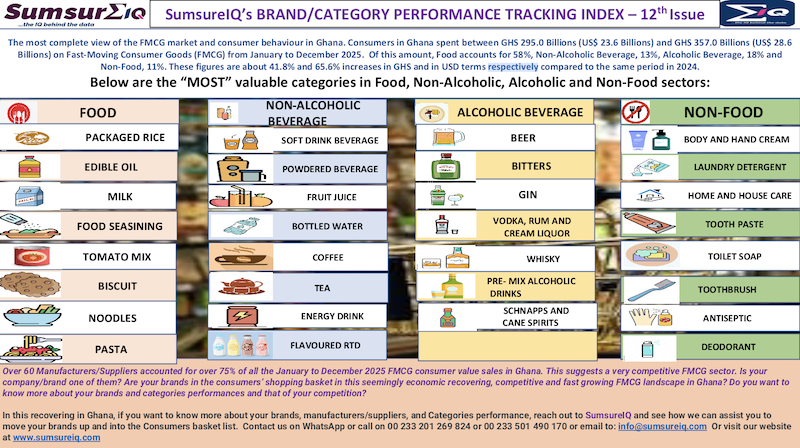
SumsureIQ has the most complete view of the FMCG market and consumer behaviour in Ghana. Consumers in Ghana spent between GHS 295.0 Billion (US$ 23.6 Billions) and GHS 357.0 Billion (US$ 28.6 Billions) on Fast-Moving Consumer Goods (FMCG) from January to December 2025. These figures are about 41.8% and 65.6% increases in GHS and in USD terms respectively compared to the same period in 2024.
Of this amount, Food accounted for 58% (a drop of -1% point compared to 2024), Non-Alcoholic Beverage, 13% (a drop of -2% point compared to 2024), Alcoholic Beverage, 18% (an increase of +5% point compared to the same period in 2024) and Non-Food, 11% (a drop of -2% point compared to 2024). These figures would suggest that, spending on Food products as a proportion of the total FMCG spending has reduced, leaving some more monies to be spent on other FMCG goods. This may further suggest less cost of living pressures. The Food Sector is still the main driver of growth in the FMCG Market in Ghana.
The data also show that over 60 Manufacturers/Suppliers accounted for more than 75% of all the January to December 2025 FMCG consumer value sales in Ghana compared to over 30 in the same period in 2024. This suggests a very competitive and several new entrants into the FMCG sector in a recovering economic landscape in Ghana. In general, SumsureIQ data may suggest that the Ghanaian economic landscape has improved and has become more competitive. This is therefore, a sign of economic recovery in 2025.
Below (in the slides) are Ghana’s TOP 30 top performing FMCG manufacturers/suppliers in 2025 as measured by consumer spending (i.e. amount of money consumers spent and the quantity consumed) on FMCG consumption were; in that order:
Questions?:
Are your brands in the consumers’ shopping basket in this seemingly economic recovery landscape in Ghana? Do you want to know more about your brands and categories performance and that of your competition?
Are you a manufacturer, a supplier, a stakeholder or a player in the FMCG market in any African country? Are you leveraging real-time retail insights to scale your business for growth?
If you wish to leverage real-time retail audit data to improve your categories and brands performances, SumsureIQ is ready to have a discussion with you.
Contact us by visiting our website at www.sumsureiq.com
According to new research conducted by the top Fast Moving Consumer Good (FMCG) market and economic research agency and consultancy company in Ghana, SumsureIQ, Ghana’s Fast Moving Consumer Goods sector has seen significant improvements in a difficult landscape characterised by cost-of-living crises, exchange rate volatility and constant inflationary pressures in 2025 compared to 2024.
Over the years, SumsureIQ research findings have been published as part of SumsureIQ’s Quarterly Brand/Manufacturer Performance Tracking Index and in National Newspapers.
Performance
The research findings show that in 2025, FMCG volume sales grew by about 13.7 per cent compared to 2024. This increase was mainly driven by Food, which accounted for about 74.4 per cent of the increase, followed by Non-Alcoholic Beverage with about 11.4 per cent of the increase, then Non-Food with 8.5 per cent and Alcoholic Beverage with just 5.7 per cent of the increase.
In terms of value sales, FMCG sales increased by about 41.8 per cent in 2025 compared to 2024. The main driver of this increase was Food, with about 56.1 per cent in the value increase, followed by Alcoholic Beverage with about 28.4 per cent on the increase.
Then, Non-Alcoholic Beverage with 9.7 per cent and Non-Food with just 5.8 per cent. The relationship between the values, sales growth rates and the volume sales rates of growth may suggest “premiumisation” of the FMCG market in Ghana.
Thus, on average, new products in 2025 commanded higher prices per standard weight.
This was more pronounced within the Alcoholic Beverage and the Non-Alcoholic Beverage segments.
These results are further corroborating evidence with previous SumsureIQ research results which showed that the average living standard of the Ghanaian consumer improved in 2025 compared to 2024, as less monies were spent on Food consumption compared to the actual proportion consumed.
Thus, more volumes of Food were consumed, proportionally, compared to the other FMCG products, with relatively less of the hard-earned disposable incomes being spent on Food leaving more to be spent on other life necessities or other FMCG goods.
These results may also indicate that although the average levels of inflation have dropped significantly compared to 2024, the impacts on the cost-of-living pressures are still being felt by the average consumer as prices are still sticky but living standards are improving, potentially, as a result of the increase in the purchasing power of the Ghanaian Cedi in 2025.
According to SumsureIQ, this improvement is good news for all Ghanaian consumers. This is because it shows the potential turning point in the average living standard deterioration in the country, which has been induced by relatively high levels of inflation and the accompanying cost-of-living crisis and compounded with the constantly fluctuating Ghanaian Cedi (GHS) against other foreign currencies.
Furthermore, the SumsureIQ research findings show that, in 2025 compared to 2024, consumption of Food categories increased by about 18.9 per cent in volume sales and 40.2 per cent in value sales.
Some of the Food categories which contributed to this growth were Rice, Edible oil, Milk, Tomato Mix and Food Seasoning/Taste Enhancers. Some of the best performing manufacturers/suppliers in 2025 were Lele, Wilmar, GB Foods, OLAM, AWB Trading, Nestle and Promasidor. And some of the top best performing brands in the Food segment were Abena, Frytol, Gino, Onga, Ideal, Maggi, Indomie, Carnation and Kivo.
The research also noted increases in the consumption of non-alcoholic beverage categories by about 5.8 per cent in volume sales and 30.3 per cent in value sales in 2025 compared to 2024.
Categories
And some of the top-performing brands were Voltic, Bel-Aqua, Verna, Malta Guinness, Milo, Bigoo, Cowbell, Coca-Cola, Fanta, Awake, Don Simon, Ceres and Storm.
Likewise, there were increases in the consumption of Alcoholic beverages as well as Non-Food categories in 2025 compared to 2024. For the Alcoholic Beverage segment, some of the top-performing manufacturers/suppliers were Accra Brewery, Diageo, Sazerac, Kasapreko, Regyadams, Adonko Bitters, GIHOC and Faxe.
Some of the top-performing brands were Club, Star, Gulder, Mr Boston, Eagle, Orijin, Club Shandy, Guinness, Kasapreko Dry Gin, Alomo, Adonko, Faxe and Lawson De-Ray Man.
Whilst the top six best performing manufacturers/suppliers and top 6 best performing brands for the Non-Food were Dream Cosmetics, Beiersdorf, Unilever, DH Industries, Wilmar and Ever Sheen. And Day-by-Day, Queen Elizabeth, Nivea, Jamaa, Key Soap and Madar respectively.
Value for money
According to Dr Erasmus L Owusu, the Founder and CEO of SumsureIQ, “consumers are progressively and constantly looking for value-for-money and affordable product propositions”.
He is of the view that this shift suggests that while the levels of inflation have significantly gone down on average, the consequential cost-of-living crisis is also abating but not over yet as prices have not reduced quickly enough, as expected by the average consumer.
This is due to constant pressures on their disposable incomes. However, there have been some improvements in the average standard-of-living of the Ghanaian consumer.
This is buttressed by SumsureIQ’s recent research findings and the most recent low levels of rate of inflation in Ghana, which has seen quite a significant decrease on the average in 2025 compared to 2024.
Furthermore, he points out that, “the latest SumsureIQ research findings dovetail the potential of Ghana’s FMCG markets recovering within the recovery of the Ghanaian economic landscape as a whole and of course, the removal of the E-Levy and the simplification of the VAT rate may boost domestic consumption, especially FMCG consumption in 2026.
However, these recent domestic tax policy changes and improvements remain cautious, tenuous and are susceptible to global economic shocks like the tariffs imposed on imports by the USA, which could be destabilising factors for the fragile recovery, as well as the exchange rate fluctuations.
These have significant impacts on the living standard given that Ghana is, at the moment, an import-dependent economy”.
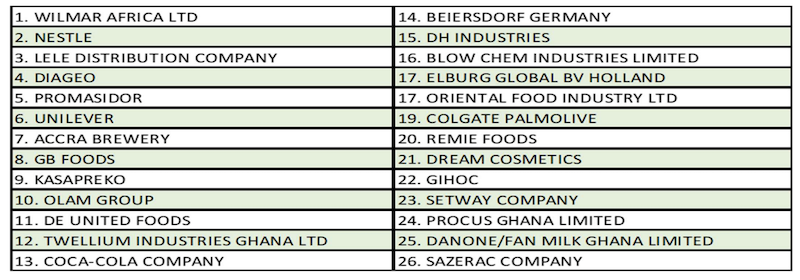
Overall, the TOP 26 FMCG manufacturers/suppliers in 2025 as measured by consumer spending (i.e. amount of money consumers spent on FMCG consumption) were; in that order:
Data collection
SumsureIQ (www.sumsureiq.com) is a full market and economic research agency and consultancy. It is the Top FMCG market Research company with Head office in Ghana.
SumsureIQ has collected over 120,000 lines of data every month since January 2022 on over 75 categories and segments of Fast-Moving Consumer Goods (FMCG) in Food, Non-Food, Alcoholic and Non-Alcoholic Beverages across all 16 administrative regions and 10 channels/store-types, including Modern Trade and Petrol Marts in Ghana.
SumsureIQ uses robust mathematical, statistical, econometric methodologies and AI techniques to estimate the market sizes of every category/manufacturer/brand.
SumsureIQ also uses the collected data to estimate a myriad of analytical KPIs. This amount of data shows that SumsureIQ has the complete view of the FMCG retail market structure, volume of consumption pattern and consumer behaviour in Ghana.
SumsureIQ has the most complete view of the FMCG market and consumer behaviour in Ghana.
Consumers in Ghana spent between GHS 295.0 Billion (US$ 23.6 Billions) and GHS 357.0 Billion (US$ 28.6Billions) on Fast-Moving Consumer Goods (FMCG) from January to December 2025.
These figures are about 41.8% and 65.6% increases in GHS and in USD terms respectively compared to the same period in 2024.
Of this amount, Food accounted for 58% (a drop of -1% point compared to 2024), Non-Alcoholic Beverage, 13% (a drop of -2% point compared to 2024), Alcoholic Beverage, 18% (an increase of +5% point compared to the same period in 2024) and Non-Food, 11% (a drop of -2% point compared to 2024).
These figures would suggest that, spending on Food products as a proportion of the total FMCG spending has reduced, leaving some more monies to be spent on other FMCG goods.
This may further suggest less cost of living pressures. The Food Sector is still the main driver of growth in the FMCG Market in Ghana.
The data also show that over 60 Manufacturers/Suppliers accounted for more than 75% of all the January to December 2025 FMCG consumer value sales in Ghana compared to over 30 in the same period in 2024.
This suggests a very competitive and several new entrants into the FMCG sector in a recovering economic landscape in Ghana. In general, SumsureIQ data may suggest that the Ghanaian economic landscape has improved and has become more competitive. This is therefore, a sign of economic recovery in 2025.
Questions?:
Are your brands in the consumers’ shopping basket in this seemingly economic recovery landscape in Ghana? Do you want to know more about your brands and categories performance and that of your competition?
Are you a manufacturer, a supplier, a stakeholder or a player in the FMCG market in any African country?
Are you leveraging real-time retail insights to scale your business for growth?
If you wish to leverage real-time retail audit data to improve your categories and brands performances, SumsureIQ is ready to have a discussion with you.
Contact us by visiting our website at www.sumsureiq.com