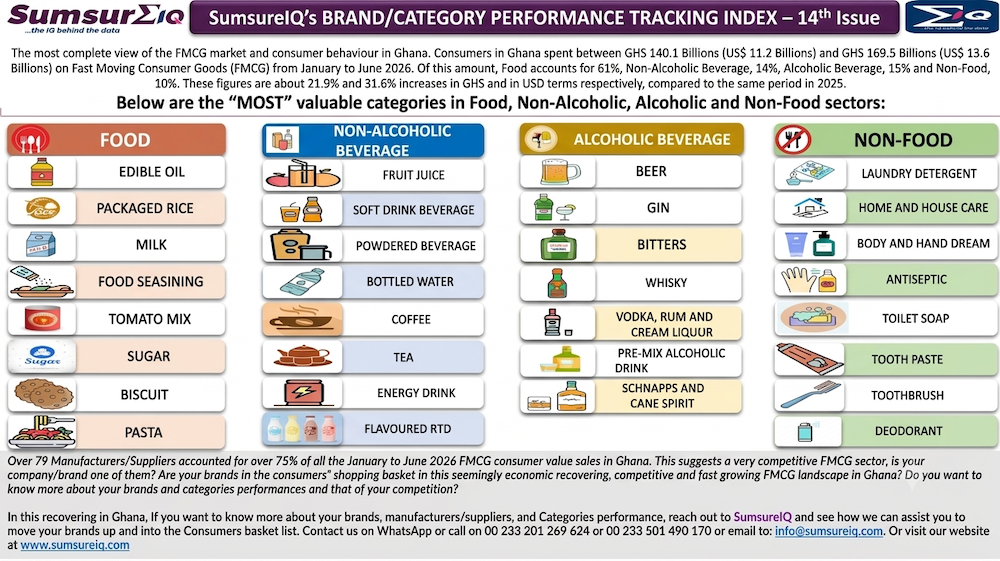
The Fast-Moving Consumer Goods (FMCG) sector in Ghana has recorded improved performance in the first half of 2026, according to new research by SumsureIQ, a leading market and economic research agency based in Ghana.
The findings indicate that volume sales and consumption in the FMCG sector grew by 3.7 per cent between January and June 2026 compared to the same period in 2025.
This recovery comes amid a challenging economic landscape characterised by declining inflation rates, though consumer prices remain sticky and exchange rate volatility persists.
Food products drive growth
Food products accounted for the bulk of the increase in volume consumption, contributing approximately 79 per cent of the growth. Non-alcoholic beverages followed with 12 per cent, alcoholic beverages with six per cent and non-food items with three per cent.
In terms of value, the actual amount consumers spent, FMCG consumption surged by 21.9 per cent during the review period compared to the first half of 2025.
Food consumption again emerged as the primary driver, accounting for 48 per cent of the value increase. Alcoholic beverages surprisingly contributed 39 per cent, while non-alcoholic beverages and non-food items accounted for 11 per cent and two per cent respectively.
Consumer preference shifts
The research identified the top 15 performing brands across various categories based on in-store transaction numbers at the Point-of-Sale (POS).
In the food category, popular brands included Onga, Kivo, Maggi, Nido, Ideal, Indomie, Remie, Carnation, Sankofa, Lyzy, Minazen, Tasty-Tom, Frytol, Kremela and Cowbell.
Non-alcoholic beverage consumers favoured Cowbell, Verna, Bigoo, Milo, Miksi, Voltic, Bel-Aqua, Kalyppo, Awake, Malta Guinness, This Way, Coca-Cola, Kaesar, Bel-Aqua Active and Don Simon.
Alcoholic beverage preferences included Club, Striker, Guinness, Orion, Abc, Orijin, Gulder, Castle Bridge, Star, Goal, Adonko, Club Shandy, Kiss, Faxe and Alomo.
Non-food items saw Madar, Jamaa, Pepsodent, Kleesoft, Colgate, Sunlight, Vip, Yazz, Key Soap, Day-By-Day, Nivea, Cuzy, Camel, Kdo and Lavita as the preferred brands.
Consumers seeking value for money
The founder and Chief Executive Officer of SumsureIQ, Dr Erasmus L Owusu, explained that consumers are increasingly purchasing medium to high pack-size items because these tend to have lower average prices per standard-base weight, making them more affordable.
“Small pack-sizes lend themselves to convenience but average price per standard-based weight tends to be relatively high. Consumers see these medium to high pack-sizes as better value for money propositions,” he said.
Dr Owusu noted that while inflation levels have dropped significantly, consumers have yet to feel these reductions in their pockets.
“The consequential cost-of-living crisis is abating but the transition mechanism to the consumer pockets is very slow,” he stated.
However, he acknowledged improvements in the average standard of living for Ghanaian consumers in the first half of 2026 compared to the same period in 2025.
“Consumers are consuming more food items, as well as having some extra income to spend on expensive alcoholic beverages and other items,” he noted.
Economic indicators improve
The research aligns with recent economic data showing Ghana’s inflation rate at 5.3 per cent year-on-year in June 2025, compared to 13.7 per cent in the same period of 2025, according to the Ghana Statistical Service.
Dr Owusu added that recent stability of the cedi against a basket of foreign currencies would enable consumers to make more calculated purchasing decisions going forward.
Cautious optimism
The latest SumsureIQ findings suggest potential for Ghana’s FMCG market recovery alongside broader economic recovery, with the removal of the E-Levy possibly boosting domestic consumption.
However, Dr Owusu cautioned that improvements remain cautious and tenuous, susceptible to global economic shocks.
“The recent US/Israel war on Iran and the consequential closure of the Strait of Hormuz could be a destabilising factor for the fragile recovery as this may have economic impacts affecting the FMCG sector,” he warned.
Research methodology
SumsureIQ collects over 120,000 lines of data monthly across more than 75 categories and segments of FMCG products in food, non-food, alcoholic, and non-alcoholic beverages.
The agency gathers data from 10 retail channels, including Modern Trade outlets and Petrol Marts across all 16 regions in Ghana.
Using robust mathematical, statistical, econometric methodologies and AI techniques, SumsureIQ estimates market sizes for every category, manufacturer and brand.
The company provides monthly Retail Audit Measurement Index (RAI) services, with data available from January 2023 to date.