If you are looking for SumSureIQ but typed samsureiq, sam sure iq, sam sure it, or samsure iq, you’ve arrived at the right place. SumSureIQ is the official and correct name of our professional market research and data intelligence platform, trusted by businesses, organizations, and institutions for accurate insights and informed decision-making.
People often spell brand names differently when searching online. Whether you searched for samsureiq or sam sure iq, all those searches point to one trusted brand — SumSureIQ.
What Is SumSureIQ?
SumSureIQ is a market research and data analytics company focused on delivering reliable, evidence-based insights. We help organizations understand markets, customers, and trends through structured research and data analysis.
Our core services include:
Market research and analysis
Consumer and field surveys
Data collection and reporting
Business and policy insights
Research consulting and strategy
So if you heard the name spoken and searched sam sure it or samsure iq, you are still referring to SumSureIQ.
Why So Many People Search “Samsureiq” or “Sam Sure IQ”
Search engines reflect how people speak. Because SumSureIQ sounds like “Sam Sure IQ,” many users naturally type variations such as:
samsureiq
sam sure iq
sam sure it
samsure iq
To be clear and transparent:
The official brand name is SumSureIQ The only official website is https://sumsureiq.com
Any spelling variation you see online refers back to SumSureIQ.
Why Choose SumSureIQ?
SumSureIQ is built on accuracy, professionalism, and real-world relevance. Clients choose us because we provide:
Dependable, high-quality data
Clear and actionable research reports
Custom research solutions for different industries
Ethical data collection standards
Local and international research capability
Whether someone finds us by searching samsureiq or sam sure iq, they experience the same trusted research expertise.
SumSureIQ vs Common Misspellings
To remove any confusion, here’s a simple clarification:
Samsureiq → SumSureIQ
Sam Sure IQ → SumSureIQ
SamSure IQ → SumSureIQ
Sam Sure It → SumSureIQ
Samsure IQ → SumSureIQ
They all lead to one brand, one team, and one official platform: SumSureIQ.
Work With SumSureIQ
If you need credible research, accurate data, and insights you can rely on, SumSureIQ is ready to support your goals. From surveys to strategic analysis, we help you make confident, data-driven decisions.
Visit the official website to learn more about our services and request a consultation today.
Official Website:https://sumsureiq.com Brand Name: SumSureIQ Focus: Market Research • Surveys • Data Intelligence
Fast-Moving Consumer Goods (FMCG) such as Food, Non-Alcoholic Beverages, Alcoholic Beverages and Non-Food products are staples in consumers’ daily lives. However, their pricing is influenced by a wide range of factors, from production to point-of-sale. Understanding how some of these factors impact on prices are essential for both consumers, retailers and manufacturers/suppliers. In this piece, SumsureIQ discusses the impacts of Exchange Rate fluctuations on Fast Moving Consumer Goods (FMCG) prices, Consumption and Consumer Behaviour.
SumsureIQ estimates that within the last 10 months (January-October 2025), on average, the Ghanaian local Currency, CEDI, (GHS) has appreciated by over +13% against other foreign currencies compared to the same period last year. These are massive gains in the value of the GHS vis-a-vis other foreign currencies. This also is an indication of fluctuating currency. Such fluctuations have massive implications for FMCG consumption and prices. SumsureIQ, therefore presents some of the possible impacts on the FMCG sector for your read.
Impacts on FMCG prices
1. Price Increases Due to Imported Inputs and finished goods
Imported Raw Materials: Many FMCG companies rely on imported inputs (e.g., packaging, ingredients, machinery). When a country’s currency depreciates, the cost of importing these goods increases leading to higher prices of FMCG products. Thus, a weaker local currency makes these imports more expensive. On the other hand, when the local currency appreciates, it makes the imported goods cheaper, potentially reducing the prices. To maintain profit margins, manufacturers often pass these increased costs on to the final consumers in the form of price increases and therefore, raising retail and FMCG prices.
2. Changes in Consumer Purchasing Power
Weaker Local Currency equals Reduced Real Incomes and conversely, Stronger Local currency leads to Increased Real Income. This is true, especially for imported or foreign-branded products. Consumers may find their money buys less of these FMCG products. These higher prices may push consumers toward local or lower-cost brands, affecting brand loyalty and product preferences.
3. Inventory and Supply Chain Challenges
Sometimes, due to uncertainty about the local currency, FMCG retailers and distributors might stock up products when the local currency is depreciating, intending to sell the products when the currency appreciates. These activities may create artificial shortages. Additionally, Exchange rate volatility can cause delays or increased costs in logistics and procurement.
4. Profit Margin Pressures
Exchange rate volatilities may cause some FMCG manufacturing companies to choose not to pass on full price increases to consumers to stay competitive, hurting profitability. However, some may adjust their pricing policing strategies to account for the fluctuation and potentially, affecting profit margins. Retailers, especially small ones, may face narrower profit margins or reduce stock variety to manage the increasing costs.
5. Export Opportunities or Challenges
One advantage of fluctuating exchange rates in a country to the local manufacturers is the potential opening of export opportunities. A weaker local currency may make domestically produced FMCG products more competitive on the international market or abroad so these local companies may take the opportunity to increase their exports. However, If production inputs and raw material are mostly imported, the cost increases may outweigh export opportunity advantages.
Impact on Consumption of FMCG products
1. Demand of FMCG products
Exchange rate fluctuations can influence demand for FMCG products. A stronger local currency may lead to increased demand for imported goods to the disadvantage of the locally produced FMCG products, while a weaker local currency may reduce the demand on imported FMCG products to the advantage of the locally produced ones.
2. Changes in Consumer Behaviour
FMCG consumers may adjust their purchasing decisions based on price changes resulting from the exchange rate volatility. For example, consumers may shift from the purchases of branded products to the purchases of retailers own brands or what is usually called the “private label” brands.
3. Substitution effect
In a period of fluctuating exchange rates, consumers may adapt to the usage of substitutes. Typically, consumers may opt for locally produced alternatives or substitute entire products in order to cope with the changing prices.
Key Considerations for FMCG Companies and Consumers
1. Hedging Strategies
In a period of exchange rate volatility, manufacturers and companies may consider using hedging strategies to limit the impact. They may use such strategies as forward contracts or options to mitigate some of the risks associated with the fluctuations.
2. Supply Chain Management
When exchange rates fluctuate, companies could adapt effective supply chain management process to help minimise their impacts on prices and hence, the level of consumption
3. Marketing Monitoring
When exchange rates fluctuate, manufacturers and companies could use market research results to closely monitor and adjust their strategies accordingly to remain competitive.
Conclusion
FMCG prices are dynamic in nature, i.e. they are not static. They respond to market trends, seasonal fluctuations, geopolitical issues, and economic policies. All these could also have impacts on exchange rates. For instance, during the festive season, prices may rise due to increased demand. Similarly, disruptions in global supply chains can cause price hikes as well.
Follow SumsureIQ for more discussions on the FMCG sector.
Are you a manufacturer/Retailer, a stakeholder or a player in the FMCG market in any African country? Are you leveraging real-time retail insights to scale your business for growth?
If you wish to leverage real-time retail audit data to improve your categories and brands share performances, SumsureIQ (www.sumsureiq.com) is ready to have a discussion with you.
Please visit our website and contact us: www.sumsureiq.com
In Ghana’s fast‐paced economy, staying ahead in the Fast-Moving Consumer Goods (FMCG) sector means more than just having a good product. It requires insight, strategic data and real-time intelligence. That’s where SumsureIQ shines.
What Is SumsureIQ?
SumsureIQ is a full-service market research agency and consultancy based in Ghana (registered in 2022). The IQ behind the data We specialize in gathering, processing, and interpreting retail and consumer data allowing businesses in FMCG, retail, manufacturing, and beyond to make decisions grounded in real evidence.
Key facts:
Over 100,000 (rising to ~120,000) lines of data collected monthly.
Coverage includes more than 70 categories in Food, Non-Food, Alcoholic & Non-Alcoholic Beverages.
Geographical reach: all 16 administrative regions of Ghana, and across multiple retail channels such as Modern Trade, Petrol Marts, etc.
Core Services of SumsureIQ
SumsureIQ offers three main service lines that address the “What?”, “Why?”, and “How/Who?” of market performance:
Marketers designing campaigns, product developers, those launching new SKUs or line extensions.
sConsultancyIQ
Bespoke analytics: big data, census & survey execution, data science/machine learning, economic & statistical consultancy.
Strategy teams, agencies, institutional clients needing custom research or predictive modelling.
Because SumsureIQ has both breadth (many categories, many regions) and depth (monthly retail audit, consumer-panel style work, etc.), clients benefit from a more holistic view of the FMCG sector.
Why FMCG Businesses in Ghana Should Use Market Research
Understanding some of the trends SumsureIQ has identified gives a preview of why their work matters:
In 2024 vs 2023, volume sales of FMCGs increased by about 3%, driven mostly by food categories; value sales increased by around 7%.
Consumer behaviour is shifting: more people are buying medium-pack sizes because they see them as better value per base weight, even under inflation pressure.
By mid-2025, growth in both volume and value has become more pronounced in food, non-alcoholic beverages, etc., signaling that Ghana’s FMCG sector may be cautiously recovering.
These insights help businesses with:
Product pricing and pack-size optimization
Channel and regional expansion strategies
Brand positioning and innovation
Forecasting demand, especially in volatile macroeconomic climates
What Sets SumsureIQ Apart
Here are some competitive advantages:
Scale of Data Coverage — large data points, many categories, all regions. This gives better representativeness.
Regular Tracking / Frequency, monthly or quarterly indices let brands react quicker rather than waiting for annual reports.
Methodological Rigor — use of statistical and econometric toolsfor estimating market sizes, brand shares, etc. This decreases bias and improves forecast reliability.
Consulting & Bespoke Services — not just data delivery, but helping interpret it, design strategy, measure impact.
SumsureIQ Ghana
FMCG market research Ghana
Retail audit Ghana
Consumer insights agency Ghana
Brand performance tracking Ghana FMCG
Market size FMCG Ghana
Distribution channels Ghana FMCG
Including geographical modifiers (“in Ghana”, “Accra”, etc.) helps for local SEO. Also, making sure internal and external links are strong (e.g. linking to SumsureIQ’s reports, to authoritative sources on FMCG trends, etc.).
Sample SEO Title Ideas
“How SumsureIQ is Transforming FMCG Market Research in Ghana”
“Top FMCG Trends in Ghana: Insights from SumsureIQ’s Retail & Consumer Data”
“Why FMCG Brands in Ghana Need SumsureIQ’s Retail Audit & Consumer Panels”
Conclusion
In a market with reducing inflation pressures, shifting consumer behavior, and varied regional dynamics, FMCG companies in Ghana can’t afford to fly blind. SumsureIQ offers a powerful toolkit: large-scale retail audit data, consumer insight, and consulting services. For brands, manufacturers, and retailers looking to sharpen strategy, improve market share, or launch new products, partnering with SumsureIQ could be the difference between lagging and leading.
In Ghana’s fast-moving consumer goods (FMCG) market, data wins. SumsureIQ helps brands, manufacturers, and retailers unlock growth with large-scale retail audits, consumer panels, and bespoke analytics.Request a demo
What is SumsureIQ?
SumsureIQ is a Ghana-based market research agency focused on delivering actionable intelligence for the FMCG sector. We combine monthly retail audit data, consumer insight studies, and consultancy services so brands can make faster, evidence-based decisions.
Core services
Our services answer the three critical questions FMCG businesses face: “What is happening?”, “Why is it happening?” and “What should we do next?”
Service
What it measures
Ideal for
sRetailIQ
Market size, brand share, channel performance, pricing, and distribution metrics from regular retail audits
Brands tracking performance and distribution across Ghana
sConsumerIQ
Consumer behaviour, purchase drivers, loyalty and pack-size preferences
Marketing teams, product developers, and campaign planners
sConsultancyIQ
Custom analytics, forecasting, and predictive models using advanced statistics and machine learning
Strategy teams and institutional clients needing bespoke studies
Why FMCG brands in Ghana need market research
Market research reduces risk. For FMCG brands operating in Ghana, timely data helps with:
Optimizing pack sizes and pricing to meet changing consumer value perceptions
Identifying under-served regions and channels for distribution expansion
Measuring campaign impact and reallocating marketing budgets efficiently
Forecasting demand in volatile economic environments
What makes SumsureIQ different?
SumsureIQ stands out because of:
Scale & coverage: extensive category and regional data across Ghana’s retail landscape.
Frequency: regular (monthly/quarterly) tracking to spot trends early.
Methodology: rigorous statistical approaches that improve accuracy and reduce bias.
Consultative delivery: we don’t just hand over reports — we help you interpret data and build strategy.
How FMCG clients typically use our insights
Common use cases for our clients include:
Launch planning and SKU rationalization
Channel performance diagnostics (Modern Trade, Petrol Marts, Traditional Trade)
Price testing and pack-size optimization
Brand health tracking and competitor benchmarking
Keywords — helping you find this page
This page is optimized for searches such as FMCG market research Ghana, retail audit Ghana, consumer insights agency Ghana, and SumsureIQ.
Ready to turn data into growth?
If your FMCG brand needs better intelligence on pricing, distribution, or consumer behaviour, SumsureIQ can help. We provide demos, custom pilot studies, and subscription reporting.
About SumsureIQ — SumsureIQ delivers retail audits, consumer insight research, and bespoke analytics for the FMCG sector in Ghana. Visit our website to download reports and case studies.
SumsureIQ has the most complete view of the FMCG market and consumer behaviour in Ghana.
SumsureIQ Quarterly top 10 FMCG BRAND/CATEGORY PERFORMANCE TRACKING INDEX Reports – 11 th Edition
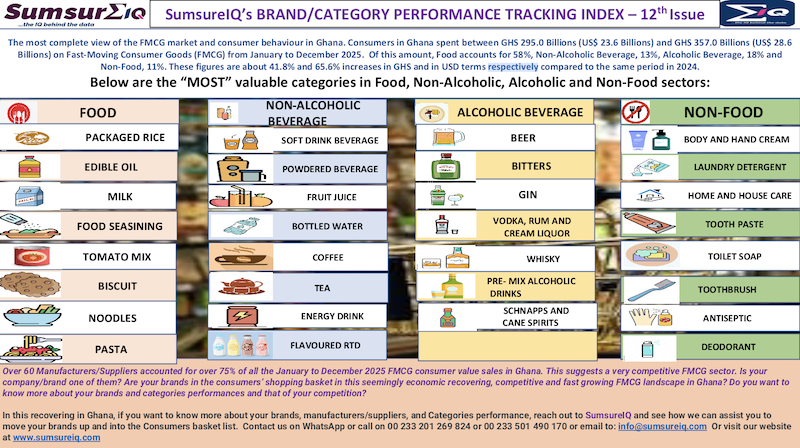
Consumers in Ghana spent between GHS 174.9 Billion (US$ 13.5 Billions) and GHS 211.6 Billion (US$ 16.6 Billions) on Fast-Moving Consumer Goods (FMCG) from January to September 2025. These figures are about 18.6% and 32.3% increases in GHS and in USD terms respectively compared to the same period in 2024.
Of this amount, Food accounted for 59% (no change compared to the same period in 2024), Non-Alcoholic Beverage, 14% (no change compared to 2024), Alcoholic Beverage, 15% (+2% point compared to the same period in 2024) and Non-Food, 12% (-1% point compared to 2024). These figures would suggest that, spending on Food products as a proportion of the total FMCG spending have been stable and that, the Food Sector is one of the main drivers of growth in the FMCG Market in Ghana.
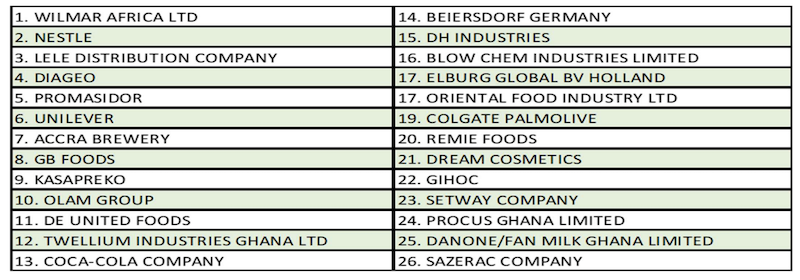
The data also show that over 55 Manufacturers/Suppliers accounted for more than 75% of all the January to September 2025 FMCG consumer value sales in Ghana compared to over 30 in the same period in 2024. This suggests a very competitive FMCG sector in Ghana. In general, SumsureIQ data may suggest that the Ghanaian economic landscape has improved and has become more competitive. This is therefore, a sign of economic recovery.
Questions?
Are your brands in the consumers’ shopping basket in this seemingly economic recovery landscape in Ghana?
Do you want to know more about your brands and categories performance and that of your competition?
Are you a manufacturer, a supplier, a stakeholder or a player in the FMCG market in any African country?
Are you leveraging real-time retail insights to scale your business for growth?
If you wish to leverage real-time retail audit data to improve your categories and brands performances, SumsureIQ is ready to have a discussion with you.
The Fast-Moving Consumer Goods (FMCG) industry is one of the most competitive markets in the world. With consumer preferences shifting rapidly and new brands entering the market every day, companies cannot rely solely on traditional research methods to stay ahead. Today, technology and market research are converging to create a powerful nexus that is transforming how FMCG businesses understand, engage, and respond to consumer needs.
Why Technology (Tech) Matters in FMCG Market Research?
Market research has always been central to FMCG strategy. From identifying market sizes, brand share performances and buying habits to tracking brand loyalty, insights drive everything from product development to marketing campaigns and their efficiency. However, the digital age has made consumer behaviour more complex, diverse, and fast-changing in the FMCG world.
Technology bridges these gaps by offering:
Big Data & Analytics: Companies can now collect and analyze data from multiple sources—retail audit, mystery shopping, social media and crowd sourcing, e-commerce platforms, loyalty cards, and consumer panels—to gain real-time insights.
Artificial Intelligence (AI) & Machine Learning (ML): AI helps businesses predict consumer demand, personalise offers, and even optimise pricing strategies.
Mobile & Online Tools: User friendly Apps, Online surveys, and Mobile panels provide efficient data collection means and quick feedback to ensure consumer engagement is easier than ever.
Social Listening Platforms: Monitoring conversations across digital platforms allows FMCG brands to track trends and respond swiftly to consumer sentiment.
What are the Benefits of Connection?
The fusion of technology with market research delivers several clear advantages:
Speed: Real-time data collection means businesses can react to consumer behaviour almost instantly.
Accuracy: Automated and AI-driven tools reduce human bias and provide more reliable insights.
Cost Efficiency: Digital research methods are often cheaper than large-scale traditional surveys.
Product Innovation: AI simulations help test new product ideas before a full launch.
Demand Forecasting: Predictive models allow companies to better manage supply chains and avoid stockouts.
Targeted Marketing: Data-driven campaigns focus on specific consumer groups, maximising Return On Investment( ROI).
Retail Insights: Point-of-sale and digital analytics reveal how and why retailers and consumers choose certain products.
Looking Ahead
The future of FMCG market research lies in deeper integration of technology. Emerging tools like blockchain for supply chain transparency, AI-driven personalisation engines and advanced retailer and consumer behaviour modeling will redefine how brands engage with customers (both retailers and consumers).
Companies that fail to embrace this nexus risk being left behind, while those that invest in tech-enabled market research will gain a stronger competitive edge over their competitors in a crowded marketplace.
In the end, the tech–market research nexus in FMCG is not just a trend—it is the future. By combining traditional research approaches with advanced technology, businesses can uncover deeper insights, make smarter decisions, and build stronger connections with their customers.
Follow SumsureIQ for more discussions on the FMCG sector.
Are you a manufacturer/Retailer, a stakeholder or a player in the FMCG market in any African country? Are you leveraging real-time retail insights to scale your business for growth?
If you wish to leverage real-time retail audit data to improve your categories and brands share performances, SumsureIQ (www.sumsureiq.com) is ready to have a discussion with you.
Please visit our website and contact us: www.sumsureiq.com
According to new research by a top market and economic research agency and consultancy in Ghana, SumsureIQ, Ghana’s Fast Moving Consumer Goods (FMCG) sector showed signs of recovery at the end of 2024 compared to 2023 from a difficult economic landscape characterised by fairly high and sticky but gradually reducing inflation levels amid cost-of-living crises.
In this mid-year research review, the findings confirm the continuous but cautious recovery of the FMCG sector in Ghana as of the first half of 2025.
Over the years, SumsureIQ research findings have been published as part of the SumsureIQ’s Quarterly Brand/Category Performance Tracking Index. In this latest research, SumsureIQ investigates the FMCG sector in Ghana to find out how it is performing as at mid-year of 2025.
The research findings show that as at the end of June 2025 (i.e. from January to June 2025), FMCG volume sales and consumption grew by about 12.5 per cent compared to the same 2024.
This increase was mainly driven by the consumption of Food products which accounted for about 75.4 per cent of the increase.
Followed by Non-Alcoholic Beverage with about 15.7 per cent of the increase, then Non-Food with 6.5 per cent of the increase and Alcoholic Beverage with just 2.4 per cent of the increase.
In terms of value (the amount of money spent), FMCG consumption increased by about 42.8 per cent (in Ghana Cedi terms) as at the end of June 2025 compared to 2024.
The main driver of this increase was also Food consumption with about 59.0 per cent of the increase, followed by , “surprisingly”, Alcoholic Beverage with about 15.3 per cent of the increase.
Then, Non-Alcoholic Beverage with 15.0 per cent and Non-Food with 10.7 per cent of the increase.
Inflation
These results are further collaborating evidence with previous SumsureIQ research results, that, the average living standard of the Ghanaian consumer which declined in 2024 compared to 2023 is now recovering during in the first six months of 2025.
Furthermore, these results indicate that, although, the levels of inflation are dropping sharply compared to the levels in 2024, they are still relatively high.
Moreover, the impact is not transmitting quickly enough down to the final consumer on average. Thus, the impact of inflation on the cost-of-living pressures, is easing but not quick enough in the first half of 2025.
However, according to SumsureIQ, the research findings may suggest that, there has been a significant expansion or improvement in the volume and value of the level of consumption in the first 6 months of 2025 compared to the same period in 2024.
This improvement is good news and a relief for many Ghanaian consumers. This is because, it shows potential turning point in the average living standard deterioration in the country which have been induced by relatively high levels of inflation and the accompanying cost-of-living crisis and compounded with the struggling Ghanaian Cedi (GHS) against other foreign currencies.
However, in the past 4-5 months, the Ghanaian Cedi has been performing well against a basket of international currencies and therefore, boosting the standard of living improvement process.
Value for money
According to Dr Erasmus L Owusu, the Founder and CEO of SumsureIQ, “consumers are purchasing progressively, more quantities in the medium to high pack sizes items range because, these pack-sizes range tend to have lower average price per standard base weight and hence, affordable”. Furthermore, “consumers see these pack sizes as better value for money propositions”.
He is of the view that, this shift suggests that, while the levels of inflation are going down, the consequential cost-of-living crises is also abating, hence, leading to some improvements in the average standard of living of the Ghanaian consumer.
This is buttressed by the most recent rate of inflation in June 2025 which is now is running at about13.7 per cent (Ghana Statistical Service) and gradually decreasing with minimal fluctuation.
What is more, with the recent appreciation of the Ghana Cedi, consumers will be making more calculated purchasing decisions”.
Furthermore, he points out that, “the latest SumsureIQ research findings harmonise the potential of Ghana’s FMCG markets recovering within the recovery of the Ghanaian economy as a whole and of course, the removal of the E-Levy may boost domestic consumption, especially, FMCGs.
However, these recent domestic changes and improvements, remains cautious, tenuous and are susceptible to global economic shocks like the recent global trade wars as a result of the array of tariffs imposed on imports by the USA could be destabilising factors for the fragile recovery”.
Data Collection
SumsureIQ (www.sumsureiq.com) is a full market and economic research agency and consultancy with Head office in Ghana.
SumsureIQ has collected about 120,000 lines of data every month since January 2022 on over 70 categories and segments of Fast-Moving Consumer Goods (FMCG) in Food, Non-Food, Alcoholic and Non-Alcoholic Beverages across all the 16 administrative regions and 10 channels/store-types including Modern Trade and Petrol Marts in Ghana.
SumsureIQ uses robust mathematical, statistical and econometric methodologies to estimate the market sizes of every category/manufacturer/brand.
SumsureIQ also uses the collected data to estimate a myriad of analytical KPIs. This amount of data shows that SumsureIQ has the complete view of the FMCG retail market structure, volume of consumption pattern and consumer behaviour in Ghana.
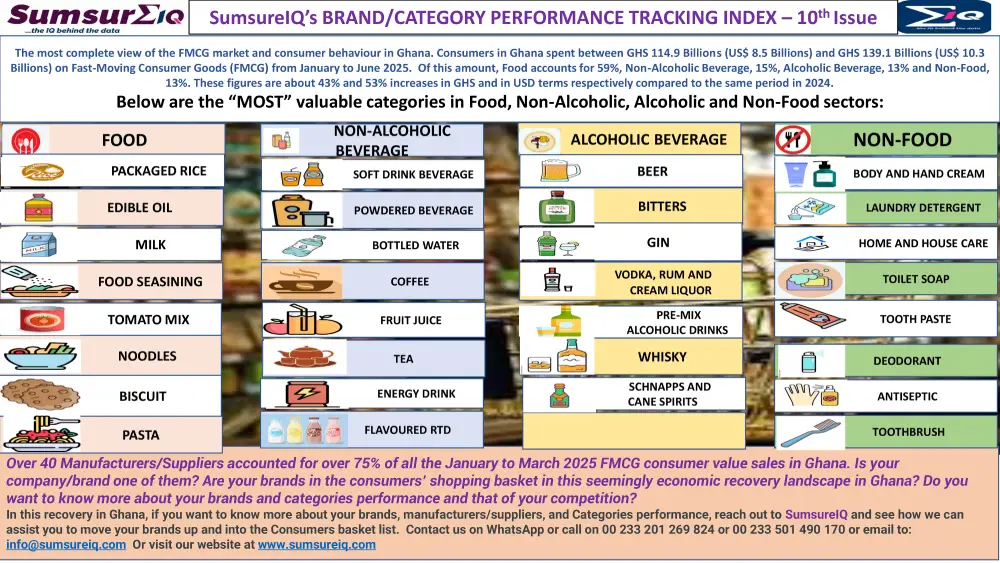
SumsureIQ has the most complete view of the FMCG market and consumer behaviour in Ghana. Consumers in Ghana spent between GHS 114. Billion (US$ 8.5 Billions) and GHS 139.1 Billion (US$ 10.3 Billions) on Fast-Moving Consumer Goods (FMCG) from January to June 2025. These figures are about 43% and 53% increases in GHS and in USD terms respectively compared to the same period in 2024.
Of this amount, Food accounted for 59% (no change compared to the same period in 2024), Non-Alcoholic Beverage, 15% (no change compared to 2024), Alcoholic Beverage, 13% (+1% point compared to the same period in 2024) and Non-Food, 13% (-1% point compared to 2024) .
These figures would suggest that, spending on Food products as a proportion of the total FMCG spending have been stable and that, the Food Sector is one of the main drivers of growth in the FMCG Market in Ghana.
The data also show that over 40 Manufacturers/Suppliers accounted for more than 75% of all the January to June 2025 FMCG consumer value sales in Ghana. In general, SumsureIQ data may suggest that the Ghanaian economic landscape has improved and therefore, on the turning point to recovery.
Questions?:
Are your brands in the consumers’ shopping basket in this seemingly economic recovery landscape in Ghana? Do you want to know more about your brands and categories performance and that of your competition?
Are you a manufacturer, a supplier, a stakeholder or a player in the FMCG market in any African country? Are you leveraging real-time retail insights to scale your business for growth?
If you wish to leverage real-time retail audit data to improve your categories and brands performances, SumsureIQ is ready to have a discussion with you.
What are the possible impacts of Exchange Rate fluctuations on FMCG prices, Consumption and Consumer Behaviour?
SumsureIQ estimates that within the last 2 to 3 months (March-May 2025), the Ghanaian local Currency, CEDI, (GHS) has appreciated by over +28% against other foreign currencies on a year-on-year basis compared to a similar rate of depreciation at the same period last year. These are massive swings in the value of the GHS vis-a-vis other foreign currencies and such fluctuations have massive implications for FMCG consumption and prices. SumsureIQ, therefore presents some of the possible impacts for your read. Impacts on FMCG prices
Price Increases Due to Imported Inputs and finished goods Imported Raw Materials: Many FMCG companies rely on imported inputs (e.g., packaging, ingredients, machinery). When a country’s currency depreciates, the cost of importing these goods increases leading to higher prices of FMCG products. Thus, a weaker local currency makes these imports more expensive. On the other hand, when the local currency appreciates, it makes the imported goods cheaper, potentially reducing the prices. To maintain profit margins, manufacturers often pass these increased costs on to the final consumers and therefore, raising retail and FMCG prices.
Changes in Consumer Purchasing Power Weaker Local Currency = Reduced Real Incomes and conversely, Stronger Local currency = to Increased Real Income. This is true, especially for imported or foreign-brand products. Consumers may find their money buys less of these FMCG products. These higher prices may push consumers toward local or lower-cost brands, affecting brand loyalty and product preferences.
Inventory and Supply Chain Challenges Due to uncertainty about the local currency, FMCG retailers and distributors might stock up products when the is depreciating, intending to sell the products when the currency appreciates, creating artificial shortages. Additionally, Exchange rate volatility can cause delays or increased costs in logistics and procurement.
Profit Margin Pressures Exchange rate volatilities may cause some FMCG manufacturing companies to choose not to pass on full price increases to consumers to stay competitive, hurting profitability. However, some may adjust their pricing policing strategies to account for the fluctuation and potentially, affecting profit margins. Retailers, especially small ones, may face narrower profit margins or reduce stock variety to manage the increasing costs.
Export Opportunities or Challenges One advantage of fluctuating exchange rates to the local manufacturers is the potential opensing of export opportunities. A weaker local currency may make domestically produced FMCG products more competitive on the international market or abroad so these local companies may take the opportunity to increase their exports. However, If production inputs and raw material are mostly imported, the cost increases may outweigh export opportunity advantages. Impact on Consumption of FMCG products
Demand of FMCG products Exchange rate fluctuations can influence demand for FMCG products. A stranger local currency may lead to increased demand for imported goods to the disadvantage of the locally produced FMCG products, while a weaker local currency may reduce the demand on imported FMCG products to the advantage of the locally produced ones.
Changes in Consumer Behaviour FMCG consumers may adjust their purchasing decisions based on price changes resulting from the exchange rate volatility. For example, consumers may shift from the purchases on branded products to the purchases of retailers own brands or private labels.
Substitution effect In a period of fluctuating exchange rates, consumers may adapt to the usage of substitutes. Typically, consumers may opt for locally produced alternatives or substitute entire products in order to cope with the changing prices. Key Considerations for FMCG Companies and Consumers
Hedging Strategies In a period of exchange rate volatility, manufacturers and companies may consider using hedging strategies to limit the impact. They may use such strategies as forward contracts or options to mitigate some of the risks associated with the fluctuations.
Supply Chain Management When exchange rate fluctuate, companies could adapt effective supply chain management process to help minimise their impacts on prices and hence, the level of consumption
Marketing Monitoring When exchange rates fluctuates, Manufacturers and companies could use market research results to closely monitor and adjust their strategies accordingly to the remain competitive Follow SumsureIQ for more discussions on the FMCG sector. Are you a manufacturer/Retailer, a stakeholder or a player in the FMCG market in any African country? Are you leveraging real-time retail insights to scale your business for growth? If you wish to leverage real-time retail audit data to improve your categories and brands share performances, SumsureIQ (www.sumsureiq.com) is ready to have a discussion with you. Please visit our website and contact us: www.sumsureiq.com
Inflation is the general increase in prices over time and has significant ripple effects across all sectors of the economy, especially FMCG (Fast Moving Consumer Goods – Food, Non-Food, Non-Alcoholic Beverages and Alcoholic Beverages). Since FMCG products are mostly life essentials, any price hike directly affects household budgets on consumption and business performances.
How Inflation affects FMCG Companies and Consumers
Rising Input Costs: In general, Inflation drives up the cost of raw materials, fuel, packaging, and labour use in the manufacturing of the FMCG products. These increase the cost of production of FMCG, forcing manufacturers to either adjust their pricing or reduce profit margins.
Shrinkflation or Package Downsizing Strategies: In periods of high levels of Inflation, instead of raising prices outright, manufacturers often reduce the weight ,size or quantity of products while maintaining the same price. This practice, known as “shrinkflation,” helps manufacturers to manage consumer perceptions but could lead to dissatisfaction
Changes in Consumer Behaviour: Prolong high levels of Inflation weakens purchasing power and chips away consumer confidence. In this situation, consumers may switch to cheaper brands, reduce consumption, or prioritise necessities over luxuries. This forces manufacturers and brands to re-evaluate their product mix and pricing strategies.
Pressure on Retailers: Retailers face higher operational costs and may struggle to balance price increases with customer retention. This can lead to increased use of promotions, discounts, or loyalty programs to maintain sales volume. In some places, this could lead to price differentiations and hence, price discrimination, especially in retail outlets where the prices are not displayed on the products.
Supply Chain Disruptions: General high Inflation levels in a country, often leads to higher fuel and transportation costs, which can strain supply chains. Delays and bottlenecks may further elevate costs or reduce product availability, hence exacerbating the upward prices pressures
Impact on the Economy and Society
Widening Economic Inequality: Inflation hits lower-income households the hardest, as they spend a larger portion of their income on FMCG essentials. This normally leads to cost-of-living crises for some sections of the society.
Policy Reactions: In most countries, the Central Banks are tasked to use monetary tools to deal with inflation. In a high level inflationary situation, Central banks may raise interest rates as a tool to combat inflation, which can slow economic growth and affect investment in FMCG businesses and hence impact on economic growth.
Shift to Local Alternatives: In a high inflationary economic landscape, imported goods become more expensive, potentially, due the impact of the exchange rate. In this situation, demand for locally manufactured substitute goods may go up allowing the local industries to compete and hence, reshaping the competitive landscape.
Follow SumsureIQ for more discussions on the FMCG sector.
Are you a manufacturer/Retailer, a stakeholder or a player in the FMCG market in any African country? Are you leveraging real-time retail insights to scale your business for growth?
If you wish to leverage real-time retail audit data to improve your categories and brands share performances, SumsureIQ (www.sumsureiq.com) is ready to have a discussion with you.