SumsureIQ Quarterly BRAND/CATEGORY PERFORMANCE TRACKING- INDEX Reports – 10 th Edition

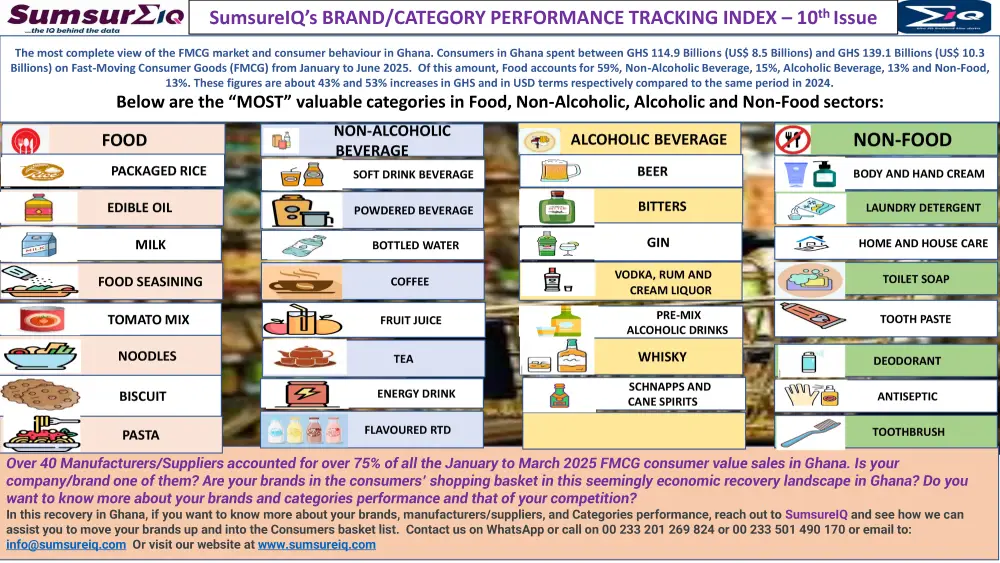
SumsureIQ has the most complete view of the FMCG market and consumer behaviour in Ghana. Consumers in Ghana spent between GHS 114. Billion (US$ 8.5 Billions) and GHS 139.1 Billion (US$ 10.3 Billions) on Fast-Moving Consumer Goods (FMCG) from January to June 2025. These figures are about 43% and 53% increases in GHS and in USD terms respectively compared to the same period in 2024.

Of this amount, Food accounted for 59% (no change compared to the same period in 2024), Non-Alcoholic Beverage, 15% (no change compared to 2024), Alcoholic Beverage, 13% (+1% point compared to the same period in 2024) and Non-Food, 13% (-1% point compared to 2024) . 

These figures would suggest that, spending on Food products as a proportion of the total FMCG spending have been stable and that, the Food Sector is one of the main drivers of growth in the FMCG Market in Ghana.

The data also show that over 40 Manufacturers/Suppliers accounted for more than 75% of all the January to June 2025 FMCG consumer value sales in Ghana. In general, SumsureIQ data may suggest that the Ghanaian economic landscape has improved and therefore, on the turning point to recovery.

Questions?:

Are your brands in the consumers’ shopping basket in this seemingly economic recovery landscape in Ghana? Do you want to know more about your brands and categories performance and that of your competition?

Are you a manufacturer, a supplier, a stakeholder or a player in the FMCG market in any African country? Are you leveraging real-time retail insights to scale your business for growth?

If you wish to leverage real-time retail audit data to improve your categories and brands performances, SumsureIQ is ready to have a discussion with you.

Contact us by visiting our website at www.sumsureiq.com

#GhanaFMCG #SumsureIQ #RetailAudit #sRetailIQ #sConsumerIQ #sConsultancyIQ #MarketResearch #RetailTrends #BrandPerformance #CategoryPerformance #AfricaMarketResearch #AfricaFMCG

What are the possible impacts of Exchange Rate fluctuations on FMCG prices, Consumption and Consumer Behaviour?

What are the possible impacts of Exchange Rate fluctuations on FMCG prices, Consumption and Consumer Behaviour?

SumsureIQ estimates that within the last 2 to 3 months (March-May 2025), the Ghanaian local Currency, CEDI, (GHS) has appreciated by over +28% against other foreign currencies on a year-on-year basis compared to a similar rate of depreciation at the same period last year. These are massive swings in the value of the GHS vis-a-vis other foreign currencies and such fluctuations have massive implications for FMCG consumption and prices. SumsureIQ, therefore presents some of the possible impacts for your read.
Impacts on FMCG prices

  1. Price Increases Due to Imported Inputs and finished goods
    Imported Raw Materials: Many FMCG companies rely on imported inputs (e.g., packaging, ingredients, machinery). When a country’s currency depreciates, the cost of importing these goods increases leading to higher prices of FMCG products. Thus, a weaker local currency makes these imports more expensive. On the other hand, when the local currency appreciates, it makes the imported goods cheaper, potentially reducing the prices. To maintain profit margins, manufacturers often pass these increased costs on to the final consumers and therefore, raising retail and FMCG prices.
  2. Changes in Consumer Purchasing Power
    Weaker Local Currency = Reduced Real Incomes and conversely, Stronger Local currency = to Increased Real Income. This is true, especially for imported or foreign-brand products. Consumers may find their money buys less of these FMCG products. These higher prices may push consumers toward local or lower-cost brands, affecting brand loyalty and product preferences.
  3. Inventory and Supply Chain Challenges
    Due to uncertainty about the local currency, FMCG retailers and distributors might stock up products when the is depreciating, intending to sell the products when the currency appreciates, creating artificial shortages. Additionally, Exchange rate volatility can cause delays or increased costs in logistics and procurement.
  4. Profit Margin Pressures
    Exchange rate volatilities may cause some FMCG manufacturing companies to choose not to pass on full price increases to consumers to stay competitive, hurting profitability. However, some may adjust their pricing policing strategies to account for the fluctuation and potentially, affecting profit margins. Retailers, especially small ones, may face narrower profit margins or reduce stock variety to manage the increasing costs.
  5. Export Opportunities or Challenges
    One advantage of fluctuating exchange rates to the local manufacturers is the potential opensing of export opportunities. A weaker local currency may make domestically produced FMCG products more competitive on the international market or abroad so these local companies may take the opportunity to increase their exports. However, If production inputs and raw material are mostly imported, the cost increases may outweigh export opportunity advantages.
    Impact on Consumption of FMCG products
  6. Demand of FMCG products
    Exchange rate fluctuations can influence demand for FMCG products. A stranger local currency may lead to increased demand for imported goods to the disadvantage of the locally produced FMCG products, while a weaker local currency may reduce the demand on imported FMCG products to the advantage of the locally produced ones.
  7. Changes in Consumer Behaviour
    FMCG consumers may adjust their purchasing decisions based on price changes resulting from the exchange rate volatility. For example, consumers may shift from the purchases on branded products to the purchases of retailers own brands or private labels.
  8. Substitution effect
    In a period of fluctuating exchange rates, consumers may adapt to the usage of substitutes. Typically, consumers may opt for locally produced alternatives or substitute entire products in order to cope with the changing prices.
    Key Considerations for FMCG Companies and Consumers
  9. Hedging Strategies
    In a period of exchange rate volatility, manufacturers and companies may consider using hedging strategies to limit the impact. They may use such strategies as forward contracts or options to mitigate some of the risks associated with the fluctuations.
  10. Supply Chain Management
    When exchange rate fluctuate, companies could adapt effective supply chain management process to help minimise their impacts on prices and hence, the level of consumption
  11. Marketing Monitoring
    When exchange rates fluctuates, Manufacturers and companies could use market research results to closely monitor and adjust their strategies accordingly to the remain competitive
    Follow SumsureIQ for more discussions on the FMCG sector.
    Are you a manufacturer/Retailer, a stakeholder or a player in the FMCG market in any African country? Are you leveraging real-time retail insights to scale your business for growth?
    If you wish to leverage real-time retail audit data to improve your categories and brands share performances, SumsureIQ (www.sumsureiq.com) is ready to have a discussion with you.
    Please visit our website and contact us: www.sumsureiq.com

FMCG #FMCGSector #sRetailIQ #sConsumerIQ #sConsultancyIQ #SumsureIQ #ExchangeRates #GhanaFMCG

Are you aware of the impact of Inflation on FMCG prices and consumption?

Inflation is the general increase in prices over time and has significant ripple effects across all sectors of the economy, especially FMCG (Fast Moving Consumer Goods – Food, Non-Food, Non-Alcoholic Beverages and Alcoholic Beverages). Since FMCG products are mostly life essentials, any price hike directly affects household budgets on consumption and business performances.

How Inflation affects FMCG Companies and Consumers

  • untickedRising Input Costs:
    In general, Inflation drives up the cost of raw materials, fuel, packaging, and labour use in the manufacturing of the FMCG products. These increase the cost of production of FMCG, forcing manufacturers to either adjust their pricing or reduce profit margins.
  • untickedShrinkflation or Package Downsizing Strategies:
    In periods of high levels of Inflation, instead of raising prices outright, manufacturers often reduce the weight ,size or quantity of products while maintaining the same price. This practice, known as “shrinkflation,” helps manufacturers to manage consumer perceptions but could lead to dissatisfaction
  • untickedChanges in Consumer Behaviour:
    Prolong high levels of Inflation weakens purchasing power and chips away consumer confidence. In this situation, consumers may switch to cheaper brands, reduce consumption, or prioritise necessities over luxuries. This forces manufacturers and brands to re-evaluate their product mix and pricing strategies.
  • untickedPressure on Retailers:
    Retailers face higher operational costs and may struggle to balance price increases with customer retention. This can lead to increased use of promotions, discounts, or loyalty programs to maintain sales volume. In some places, this could lead to price differentiations and hence, price discrimination, especially in retail outlets where the prices are not displayed on the products.
  • untickedSupply Chain Disruptions:
    General high Inflation levels in a country, often leads to higher fuel and transportation costs, which can strain supply chains. Delays and bottlenecks may further elevate costs or reduce product availability, hence exacerbating the upward prices pressures

Impact on the Economy and Society

  • Widening Economic Inequality: Inflation hits lower-income households the hardest, as they spend a larger portion of their income on FMCG essentials. This normally leads to cost-of-living crises for some sections of the society.
  • Policy Reactions: In most countries, the Central Banks are tasked to use monetary tools to deal with inflation. In a high level inflationary situation, Central banks may raise interest rates as a tool to combat inflation, which can slow economic growth and affect investment in FMCG businesses and hence impact on economic growth.
  • Shift to Local Alternatives: In a high inflationary economic landscape, imported goods become more expensive, potentially, due the impact of the exchange rate. In this situation, demand for locally manufactured substitute goods may go up allowing the local industries to compete and hence, reshaping the competitive landscape.

Follow SumsureIQ for more discussions on the FMCG sector.

Are you a manufacturer/Retailer, a stakeholder or a player in the FMCG market in any African country? Are you leveraging real-time retail insights to scale your business for growth?

If you wish to leverage real-time retail audit data to improve your categories and brands share performances, SumsureIQ (www.sumsureiq.com) is ready to have a discussion with you.

Please visit our website and contact us: www.sumsureiq.com

#FMCG #FMCGSector #sRetailIQ #sConsumerIQ #sConsultancyIQ #SumsureIQ

Are you aware of the differences between Retail Audit Index (RAI) and Retail Store Observation (RSO) approaches of Market research?

Here are the main differences . You may also visit SumsureIQ Website (www.sumsureiq.com) for more details.

SumsureIQ is a full service market research agency. We provide a variety of market research products based on robust econometric and statistical approaches.

Our main product is Retail Audit Index (RAI) for which we have monthly data from January 2022 to date for over 70 segments/categories. We also do Retail Store Observations (RSO). However, these are bespoke researches based on client specifications/requirements and objectives. For more details on our services and product range, visit our website at www.sumsureiq.com

Are you a manufacturer/Retailer, a stakeholder or a player in the FMCG market in any African country? Are you leveraging real-time retail insights to scale your business for growth?

If you wish to leverage real-time retail audit data to improve your categories and brands share performances, SumsureIQ (www.sumsureiq.com) is ready to have a discussion with you.

Please visit our website and contact us: www.sumsureiq.com

#FMCG #FMCGSector #RetailAuditIndex #RetailStoreObservation #SumsureIQ #sRetailIQ #sConsumerIQ #MarketResearch #TopBrands #TopManufacturers

SumsureIQ Quarterly BRAND PERFORMANCE TRACKING INDEX Reports – 9th Edition

Top_10_brands_GH_Jan_Mar_2025

SumsureIQ has the most complete view of the FMCG market and consumer behaviour in Ghana.

Consumers in Ghana spent between GHS 57.7 Billion (US$ 3.7 Billions) and GHS 63.5 Billion (US$ 4.1 Billions) on Fast-Moving Consumer Goods (FMCG) from January to March 2025. These figures are about 29% and 4% increases in GHS and in USD terms respectively compared to the same period in 2024.

Of this amount, Food accounted for 60%, Non-Alcoholic Beverage, 15%, Alcoholic Beverage, 12% and Non-Food, 13%. These figures would suggest that, Food have increased by 1% point compared to the same period in 2024 and that, the Food Sector is one of the main drivers of growth in the FMCG Market in Ghana.

The data also show that over 40 Manufacturers/Suppliers accounted for more than 75% of all the January to March 2025 FMCG consumer value sales in Ghana. In general, SumsureIQ data may suggest that there is some recovery in Ghanaian economic landscape.

Questions?:

Are your brands in the consumers’ shopping basket in this seemingly economic recovery landscape in Ghana? Do you want to know more about your brands and categories performance and that of your competition?

Are you a manufacturer, a supplier, a stakeholder or a player in the FMCG market in any African country?

Are you leveraging real-time retail insights to scale your business for growth?

If you wish to leverage real-time retail audit data to improve your categories and brands performances, SumsureIQ is ready to have a discussion with you.

Contact us by visiting our website at www.sumsureiq.com

#GhanaFMCG #SumsureIQ #RetailAudit #sRetailIQ #sConsumerIQ #sConsultancyIQ #MarketResearch
#RetailTrends #BrandPerformance #CategoryPerformance #AfricaMarketResearch #AfricaFMCG

The Power of Fieldwork and Retailer Engagement in Retail Audit Measurement!

Ever wondered what SumsureIQ Field Auditors do on the field? Their role is crucial in ensuring accurate and reliable market insights for our clients through quality data collection and engaging with the retailers as well as consumers. Here is how they make it happen:

✅ Outlets Audits & Assessments – They visit retail outlets every month to check product availability, pick up stock levels and purchases, record prices and placement.

✅ Retailers Engagement – They interact with the retailers (the outlet owners) every month to gather real-time feedback and buying behaviours of consumers.

✅ Competitor Analysis – The data they collect track market trends and how competitors are positioning their products (both new launches and already existing ones).

✅ Data Accuracy & Verification – They ensure that all collected data are precise by reducing errors so that the data can be used for analysis in order to have an informed decision-making process.

At SumsureIQ, we ensure that our field auditors are well-equipped with the latest technology (leveraging AI App) and robust auditing methodology skills to deliver real-time, accurate, robust and high-quality data that drives impactful business tactical and strategic decisions!

Are you a manufacturer, a stakeholder or a player in the FMCG market in any African country? Are you leveraging real-time retail insights to scale your business for growth? If you wish to leverage real-time retail audit data to improve your categories and brands performances, SumsureIQ is ready to have a discussion with you.

Please visit our website and contact us: https://sumsureiq.com hashtag#RetailAudit hashtag#FieldworkMatters hashtag#SumsureIQ hashtag#DataDrivenDecisions hashtag#BusinessGrowth hashtag#MarketResearch hashtag#DataAccuracy hashtag#Sunyani hashtag#sRetailIQ hashtag#sConsumerIQ hashtag#sConsultancyIQ, hashtag#FMCGGhana Dr Erasmus L Owusu, PhD., Bright Alorwoyie, Frank Woode, Winifred Harriet Asante, Shadrack Kankam, JOSHUA NARGEH, CA, PEARL SENYAGLO make 2000 characters

​

Did you know that over 75% of FMCG brands in African Countries lack real-time retail data?

Did you know that over 75% of FMCG brands in African Countries lack real-time retail data?

This gap leads to stock mismanagement, lack of knowledge about their route-to-market (RtM), lack of knowledge about your brand coverage, low levels of product and brand awareness, low sales growth and ultimately,  lower than expected profits.

These are some of the missed opportunities that real-time data from SumsureIQ can help to plug and fix about your brands!

At SumsureIQ, we support brands and manufacturers to bridge this gap with our monthly Retail Audit Measurement Services (sRetailIQ) in FMCG, our Consumer Measurement Services (sConsumerIQ) and our Bespoke Consultancy Services (sConsultancyIQ)—giving businesses accurate data to make smarter, tactical and strategic decisions.

📌 Key FMCG Retail data Trends for 2025:
Increased digital transformation in retail audits
🔘 Capture the growing consumer preference for value-driven brands
🔘 Leverage the power of the rise of hyper-local consumer insights
🔘 Improving the usage of real-time retail market data and brand  coverage
🔘 Robust methodology for the predicting of customer preferences
🔘 Improving stocks and inventory management

Are you leveraging real-time retail insights to scale your business for growth? If you wish to leverage real-time retail audit data to improve your brand performance, SumsureIQ is ready to have a discussion. Please check our website and contact us: https://sumsureiq.com
“hashtag#GhanaFMCG hashtag#sRetailIQ hashtag#sConsumerIQ hashtag#sConsultancyIQ hashtag#SumsureIQ hashtag#MarketResearch hashtag#RetailTrends hashtag#BrandPerformance hashtag#CategoryPerformance hashtag#AfricaBusiness hashtag#AfricaFMCG

FMCG sector shows signs of recovery in 2024

According to new research by SumsureIQ, a top market and economic research agency and consultancy in Ghana, Ghana’s Fast-Moving Consumer Goods (FMCG) sector is showing signs of improvement in 2023 and 2024, despite a difficult landscape characterised by cost-of-living crises and constant inflationary pressures.

Over the years, SumsureIQ research findings have been published as part of the SumsureIQ’s Quarterly Brand/Manufacturer Performance Tracking Index.

The research findings show that in 2024, FMCG volume sales grew by about three per cent compared to 2023. This increase was mainly driven by food, which accounted for about 42 per cent of the rise. This was followed by non-alcoholic beverages, which accounted for about 34 per cent of the increase, alcoholic beverages, which accounted for 17 per cent, and non-food, which accounted for just seven per cent of the increase.

In terms of value, FMCG sales went up by about seven per cent in 2024 compared to 2023.

The main driver of this increase was food, with about 54 per cent in value increase, followed by non-alcoholic beverages, with about 29 per cent of the rise. Then, alcoholic beverages, with 16 per cent, and non-food, with just one per cent.

These results are further corroborating evidence with previous SumsureIQ research results, that the average living standard of the Ghanaian consumer declined in 2024 compared to 2023 as more monies were spent on food but actually, fewer volumes were consumed compared to the other FMCG products with little of the hard-earned disposable incomes left to spend on other life necessities.

These results indicate that, although inflation levels are dropping comparatively in 2024, they are still high and increasing steadily. On average, the impacts of the cost of living pressures did not ease or reduce in 2024 compared to 2023.

However, according to SumsureIQ, the volume of consumption in 2024 increased or improved compared to 2023.

This improvement is good news for all Ghanaian consumers. It shows a potential turning point in the country’s average living standard deterioration, which has been induced by relatively high levels of inflation, the accompanying cost-of-living crisis, and the struggling cedi against other foreign currencies.

One of the key trends highlighted in this research and previous SumsureIQ research findings is the shift in consumer behaviour towards the spending on and consumption of food and other essential for life categories.

The SumsureIQ research finds that consumers are purchasing progressively more quantities of items in the medium pack size range on average. 

These items, in most cases, have a lower average price per standard base weight and are affordable. Additionally, consumers see them as better value-for-money propositions.

This shift suggests that while high levels of inflation and the consequential cost of living crises have caused a reduction in the average standard of living, the rate of inflation is now fairly stable with minimal fluctuation, hence, consumers make more calculated purchasing decisions.

Further SumsureIQ research findings show that in 2024 compared to 2023, consumption of Food categories increased by about 2.4 per cent in volume and seven per cent in value.

Some food categories that contributed to this growth were Edible oil, Food Seasoning/Taste Enhancers, Tomato Mix, Milk, Pasta, Biscuits, and Yoghurt. The research also noted increases in the consumption of non-alcoholic beverage categories by about 3.9 per cent in volume and nine per cent in value in 2024 compared to 2023.

The categories driving this growth were water, powdered beverages, tea, plant-based and milk. Likewise, there were increases in the consumption of non-food, and alcoholic beverages categories in 2024 compared to 2023. According to Dr Erasmus L Owusu, the Founder and CEO of SumsureIQ, “the latest research findings proffer a detailed view of the potential of Ghana’s FMCG markets recovering within the recovery of the Ghanaian economy as a whole.

However, these recent improvements remain tenuous and are susceptible to global economic shocks and exchange rate fluctuations”.

Data Collection

SumsureIQ is a full market and economic research agency and consultancy based in Ghana. We collect over 100,000 lines of data each month on over 70 categories and segments of Fast-Moving Consumer Goods (FMCG) in Food, Non-Food, Alcoholic and Non-Alcoholic Beverages across all 16 administrative regions and 10 channels/store types, including Modern Trade and Petrol Marts in Ghana. SumsureIQ uses robust statistical and econometric methodologies to estimate the market sizes of each category/ manufacturer/brand. It also estimates a myriad of analytical KPIs.

This data shows that SumsureIQ has a complete view of the FMCG retail market structure, volume of consumer consumption and consumer behaviour in Ghana. — Credit- SumsureIQ

SumsureIQ’s BRAND PERFORMANCE TRACKING INDEX – 8th Issue

The most complete view of the FMCG market and consumer behaviour in Ghana. Consumers in Ghana spent between GHS 208.1 Billions (US$ 14.3 Billions) and GHS 251.8 Billions (US$ 17.3
Billions) on Fast-Moving Consumer Goods (FMCG) from January to December 2024. Of this amount, Food accounts for 59%, Non-Alcoholic Beverage, 15%, Alcoholic Beverage, 13% and
Non-Food, 13%. These figures are about 7% increase and -20% decrease in GHS and in USD terms respectively compared to 2023.

30 Manufacturers/Suppliers accounted for over 75% of all the January to December 2024 FMCG consumer value sales in Ghana. Is your company/brand
one of them? Are your brands in the consumers’ shopping basket in this tough economic landscape? Do you want to know more about your brands and
categories performance and that of your competition?

In this cost-of-living crises in Ghana, if you want to know more about your brands, manufacturers/suppliers, and Categories performance, reach out to SumsureIQ and see how
we can assist you to move your brands up and into the Consumers basket list. Contact us on WhatsApp or call on 00 233 201 269 824 or 00 233 501 490 170 or email to:
info@sumsureiq.com Or visit our website at www.sumsureiq.com

The most complete view of the FMCG market and consumer behaviour in Ghana.

Consumers in Ghana spent between GHS 147.5 Billions (US$ 10.2 Billions) and GHS 178.4 Billions (US$ 12.3 Billions) on Fast-Moving Consumer Goods (FMCG) from January to September 2024. Of this amount, Food accounts for 59%, Non-Alcoholic Beverage, 14%, Alcoholic Beverage, 13% and Non-Food, 14%.

30 Manufacturers/Suppliers accounted for over 75% of all the January to September 2024 FMCG consumer value sales in Ghana. Is your company/brand one of them? Are your brands in the consumers’ shopping basket in this tough economic landscape? Do you want to know more about your brands and categories performance and that of your competition?

In this cost of living crises in Ghana, if you want to know more about your brands, manufacturers/suppliers, and Categories performance, reach out to SumsureIQ and see how we can assist you to move your brands up and into the Consumers basket list. Contact us on WhatsApp or call on +233 201 269 824 or +233 501 490 170 or email to: info@sumsureiq.com Or visit our website at www.sumsureiq.com

Dr Erasmus L Owusu, PhD. , Bright Alorwoyie, JOSHUA NARGEH, CA, @WinnifredAsante Cordelia Owusu